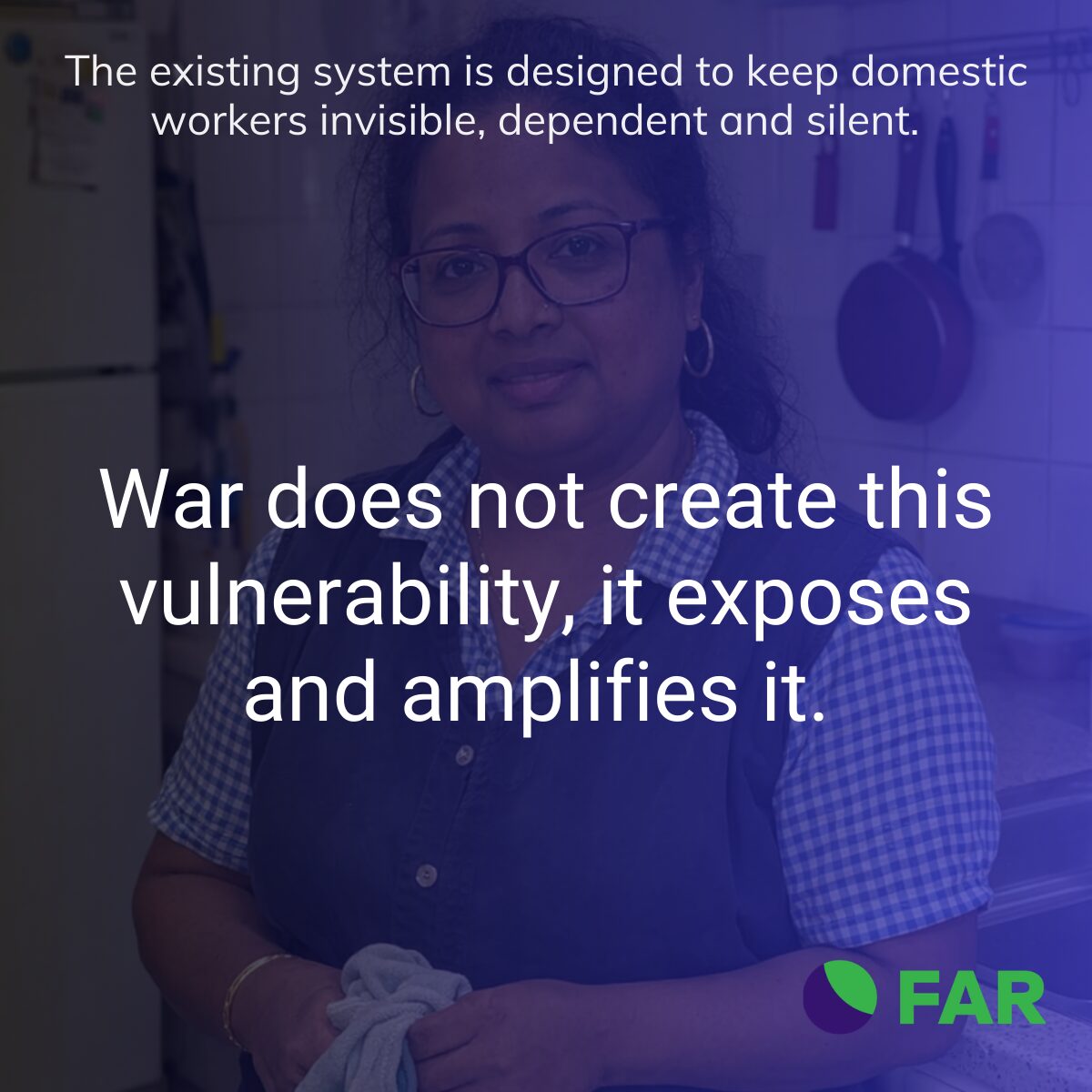
Feminist solidarity with migrant women workers amid escalating conflict in the Middle East
The Feminist Alliance for Rights (FAR) stands in full and urgent solidarity with migrant coalitions and organizations* calling for the protection of migrant workers amid the escalating armed conflict in the Middle East. As an alliance working at the intersection of women’s rights, labour rights, and migration, this crisis sits at the centre of our mandate.
Over 30 million migrant workers are currently living and working across the Gulf Cooperation Council (GCC) countries, Jordan, Lebanon, Israel, Palestine, and Iran. They include domestic workers, care workers, nurses, cleaners, construction workers, farmworkers, and drivers who keep destination and origin economies functioning and whose remittances sustain families and communities. In the midst of armed conflict, many of these workers face both immediate physical danger and the deep structural exclusion that existed before the war.
The gendered face of this crisis
FAR draws particular attention to the situation of migrant women workers – and above all, domestic workers. Largely excluded from labour protections across the GCC, migrant domestic workers are tied to individual employers, frequently through the Kafala (sponsorship) system** or tied-visa arrangements that increase risks because their work is private and isolated. Many live in employers’ homes and lack access to their own documents, freedom of movement, or independent channels of communication.
In the context of armed conflict, this exclusion becomes life-threatening. Migrant workers are among the least likely to receive timely information, medical attention, or evacuation assistance. The Kafala or sponsorship system can prevent workers from leaving dangerous situations and can enable wage theft, forced overtime, and unlawful dismissals.
For women migrant workers, risks increase in times of conflict. Gender-based violence and sexual harassment – including from employers – intensifies as domestic workers are trapped in employers’ homes without safe channels to report it or escape it. Their sexual and reproductive health and rights, already largely ignored under normal circumstances, become entirely invisible in emergency response frameworks.
FAR highlights how being a migrant, a woman, a domestic worker, and belonging to a socially disadvantaged group can multiply vulnerability.
Why feminist organizations must speak on labour and migration
Feminist politics has always understood that the personal is political and the political is always structural. The woman who migrates as a domestic worker because she cannot earn a living wage in her own country is not making an easy choice. She has to navigate in a world where global economic markets have failed to recognize and value women’s care work, and within immigration systems designed to extract labour while withholding rights. Her migration is a feminist issue. Her safety in a war zone is a feminist issue. Her right to leave, to be paid, and to return home safely are feminist concerns.
Our demands
FAR fully endorses the Coalition on Labor Justice for Migrants in the Gulf and migrant organizations’ demands, with an emphasis on protection for women migrant workers. FAR calls on feminist and women’s human rights organizations everywhere to join this appeal, amplify affected workers’ voices, and press governments for immediate measures. The struggle for migrant workers’ rights and the struggle for gender justice are inseparable. We call on governments – in destination countries, countries of origin, and across the international community- to act now.
FAR will continue to push for safety, accountability, and structural change. We stand with women migrant workers who are frequently overlooked by states, employers, and the wider public. No woman worker should be invisible. We call on authorities, employers, and humanitarian actors to identify, protect, and support those at risk.
Issued by
Feminist Alliance for Rights (FAR)
*FAR is not part of the Coalition on Labor Justice for Migrants in the Gulf, but we fully support its Urgent Call to Action, March 9, 2026. Further reading: International Domestic Workers Federation- Call to Action , March 6, 2026
**The Kafala system is a temporary labor migration regime that ties migrant workers’ residency status to their employer. This system establishes a legal relationship between the worker, their sponsor, and the state, which places immense power in the hands of employers. Read more about it: 1, 2.